

🏛️ Source Information
Source: The Boston Globe
Publisher: https://www.bostonglobe.com
Published: February 3, 2026 at 9:00 AM
Article URL: Read Full Article
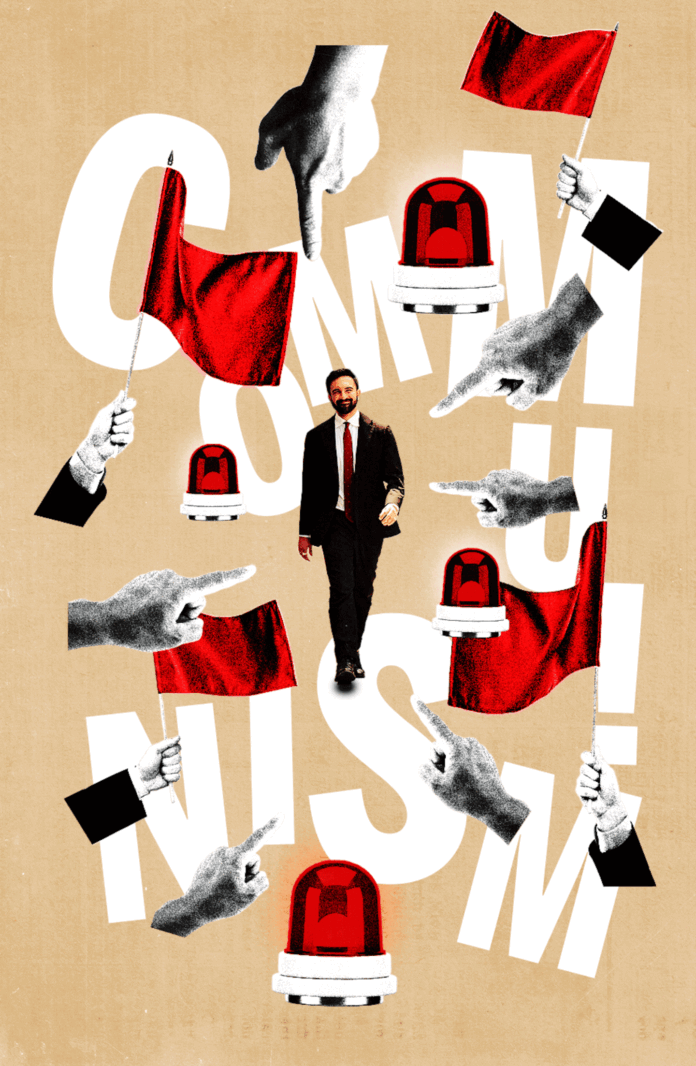
Conservatives have many bad habits, but few are more revealing than the way they talk about American socialism. They reach straight for the horror reel. Labor camps. Starvation. Soviet queues. CCP surveillance. It is rhetorically effective, in the way a foghorn is effective in a library. It’s also analytically lazy. By invoking mass graves, conservatives avoid engaging with what figures like Zohran Mamdani actually represent in an American context. The result is a moral performance that satisfies the performer but explains nothing and persuades no one.
The latest example comes from James Piereson, a long-standing conservative polemicist and senior fellow at the Manhattan Institute. In his hands, “socialism” is never a specific policy agenda or a modern welfare state. It is an all-purpose scarecrow. A stitched-together gallery of Mao, Stalin, and Pol Pot, padded out with grainy black-and-white corpses, invoked against contemporary America like a curse.
Piereson is hardly alone. Versions of the same argument echo across conservative media, from Victor Davis Hanson’s civilizational alarms, to Mark Levin’s tendency to treat modern progressivism as an inevitable slide toward Marxism, to Dinesh D’Souza and Dennis Prager’s insistence that any expansion of the welfare state is merely totalitarianism in its early stages. At outlets like The Federalist, the pattern is even more pronounced: Housing policy, labor protections, and industrial planning are no longer debated so much as foretold, each cast as another step toward barbed wire and blacklists. The targets may change, but the conclusion remains the same.
Scandinavian tax rates, student debt relief, and rent controls are frog-marched to the gulag. History is distorted. Distinctions disappear. Fear does the heavy lifting. It is easier, after all, to shout “totalitarianism” than to grapple with present-day economics and far safer to exhume the past than to confront the present.
This sleight of hand badly misreads why younger voters are drifting left. A 2025 report by the Cato Institute and YouGov found that 62 percent of Americans aged 18-29 view socialism favorably. That figure is often read as ideological radicalism. It is more accurately read as exhaustion. These voters aren’t nostalgic for mass-murdering regimes or misty-eyed about central planning. They are worn down by being told that a system clearly failing them is the only real option and that questioning it borders on blasphemy.
If the choice were truly between traditional capitalism and traditional socialism, the debate would be over before it began. Capitalism wins every time. Markets allocate resources better than committees. Prices carry information beyond what words can convey. Competition rewards effort and curbs complacency. Work retains dignity because it produces something real. Even capitalism’s critics rely on its outputs. No serious person doubts this.
But that is not the choice young Americans see. What they experience isn’t capitalism as advertised but capitalism as practiced by a narrow elite. Oligarchy dressed up as innovation. Financial engineering replacing production. Rent-seeking masquerading as entrepreneurship. Bailouts delivered with solemn speeches about responsibility. Losses absorbed by the public. Gains quietly pocketed. Risk for thee. Protection for me.
This pattern didn’t begin with Trump, but it has accelerated since his return to office. Tariffs were reimposed. Big firms stayed big. Banks stayed protected. Lobbyists stayed well fed. Young workers were still told to hustle harder while asset holders watched values climb. The aforementioned Cato Institute has conceded that this looks more like a managed system tilted toward the already powerful than a free market. When conservatives present this arrangement as capitalism in its pure form, they are asking people to deny what they encounter every day.
Socialist rhetoric fills the gap left by that denial. Not because it is correct but because it names a grievance others refuse to acknowledge. It tells young voters that their frustration is real. That something has gone wrong. That the system isn’t simply misunderstood but malfunctioning. Conservatives often respond by calling these voters naive or dangerous. This may feel satisfying, but it’s entirely counterproductive. It’s like lecturing a drowning man on the virtues of dry land or someone on the verge of homelessness about real estate discipline.
What Mamdani and similar figures offer is best understood as a protest signal, fired into a political sky where ordinary life barely registers. High rents. Precarious work. Wages that lag prices. A future that seems to offer less than the past once promised. That doesn’t make the newly elected mayor’s prescription harmless. It relies on blunt tools such as price regulation and state-directed redistribution, which tend to reduce supply, distort incentives, and entrench shortages. New York’s housing crisis didn’t emerge from a lack of regulation alone, and it won’t be solved by treating capital as if it responds to sentiment rather than economic reality. In practice, these policies risk worsening the very problems they claim to address: less construction, fewer jobs, and a permanent scramble for politically allocated scarcity. The attraction is understandable. The remedies are not.
Conservatives, however, rarely meet that distinction head-on. Faced with that frustration, they reach for patronizing lectures about Stalin, sounding less like critics of bad policy than people debating spirits at a seance.
Many of the young voters flirting with socialism aren’t antimarket. They’re antirigged. They don’t hate profit. They hate insider profit. They aren’t hostile to success. They’re hostile to systems where success appears increasingly inherited, insulated, and immune to failure. Conservatives once understood this distinction. It was central to their case against aristocracy and central planning alike.
Instead, parts of the right now default to reflexive labeling rather than serious differentiation. While figures like JD Vance and Josh Hawley increasingly talk, whether sincerely or strategically, about corporate abandonment and consolidation and working-class betrayal, the broader conservative ecosystem often responds to similar critiques from the left with a reflexive charge of “socialism.”
The dark joke is that conservatives are right about socialism’s failures, but they misread why it attracts support. It appeals not because young Americans want commissars but because they see a system that rewards proximity to power over contribution. They see executives rescued and workers treated like subhuman scum. They see rules enforced downward and waived upward. They hear talk of merit paired with a reality of connections and carve-outs.
If conservatives want to win this argument, they need to stop fighting caricatures and start addressing conditions. That means confronting monopolies directly, without euphemism. It means opposing bailouts on principle, not just when Democrats propose them. Most of all, it means acknowledging that anger can be warranted even when the proposed remedies are not.
You don’t defeat bad ideas by pretending they came from madness. Instead, you defeat them by understanding why they sound reasonable to people who feel trapped. Right now, socialism is less a doctrine than a diagnosis. Conservatives ignore that at their peril.

